

Congress enacted the GENIUS Act in July 2025 to establish a national regulatory framework for payment stablecoins. The Act deliberately separates stablecoin issuance from insured depository institutions, requiring credit unions and banks to participate only through licensed issuing entities rather than issuing directly.
On February 12, 2026, the National Credit Union Administration published a proposed rule implementing its portion of the GENIUS Act. This proposal focuses narrowly on licensing, approval, and investment structure for credit-union-related stablecoin issuers. It does not yet establish capital, liquidity, technology, or operational requirements for issuing stablecoins.
In short, this rule answers who may issue stablecoins and through what structure. A future rulemaking will address how issuance must operate in practice.
Five Things Illinois Credit Unions Need to Know Now
1. Credit unions may not issue stablecoins directly
The GENIUS Act explicitly prohibits insured credit unions—federal or state-chartered—from issuing payment stablecoins themselves. Any participation must occur through a licensed subsidiary approved by NCUA.
2. For federal credit unions, issuance effectively means a CUSO structure
NCUA reaffirms its long-standing interpretation that subsidiaries providing services tied to routine credit-union operations must meet Part 712 (CUSO) requirements. As a result, Illinois FCUs should expect stablecoin issuance to occur through a CUSO-compliant entity.
3. State-chartered credit unions may have more flexibility in how subsidiaries are formed—but federal insurance still determines who regulates stablecoin issuance
Illinois state-chartered credit unions operate under Illinois law, which can allow a wider range of subsidiary structures than those available to federal credit unions, including subsidiaries that are not traditional CUSOs. This means state law may provide greater flexibility in how an issuing entity is organized.
However, once a state-chartered credit union is federally insured, Congress has determined that any subsidiary issuing a payment stablecoin must be licensed and supervised by the NCUA, regardless of how that subsidiary is formed under state law. In other words, state law governs structure, but federal law governs stablecoin oversight.
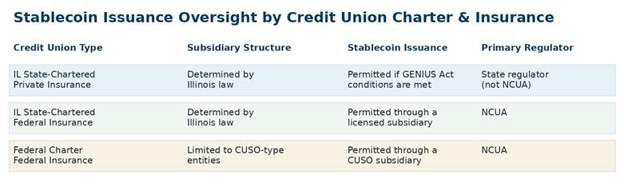
Figure 1. While state law may affect how subsidiaries are formed, federal insurance determines who regulates stablecoin issuance.
4. NCUA expects cooperative, multi-credit-union models
The proposed rule anticipates that stablecoin issuers will often be jointly owned by multiple credit unions. NCUA intentionally designed the application process to support shared ownership and consortium-style entities rather than requiring each credit union to apply individually.
5. What NCUA has not said yet is just as important
The proposal does not yet address:
The NCUA’s proposed stablecoin rulemaking represents an important structural milestone, not an immediate operational shift. The GENIUS Act establishes that credit unions may participate in stablecoin activity only through licensed subsidiaries, and NCUA’s proposal clarifies how that participation would be approved and supervised.
For Illinois credit unions, the immediate focus should be awareness and understanding, not execution. Key operational, capital, and examiner expectations have not yet been defined and will be addressed in future rulemaking.
As the regulatory framework continues to develop, the Illinois Credit Union League will remain focused on advocacy, charter parity, and ensuring that any final rules appropriately reflect the cooperative structure, risk profile, and mission of credit unions operating in Illinois.